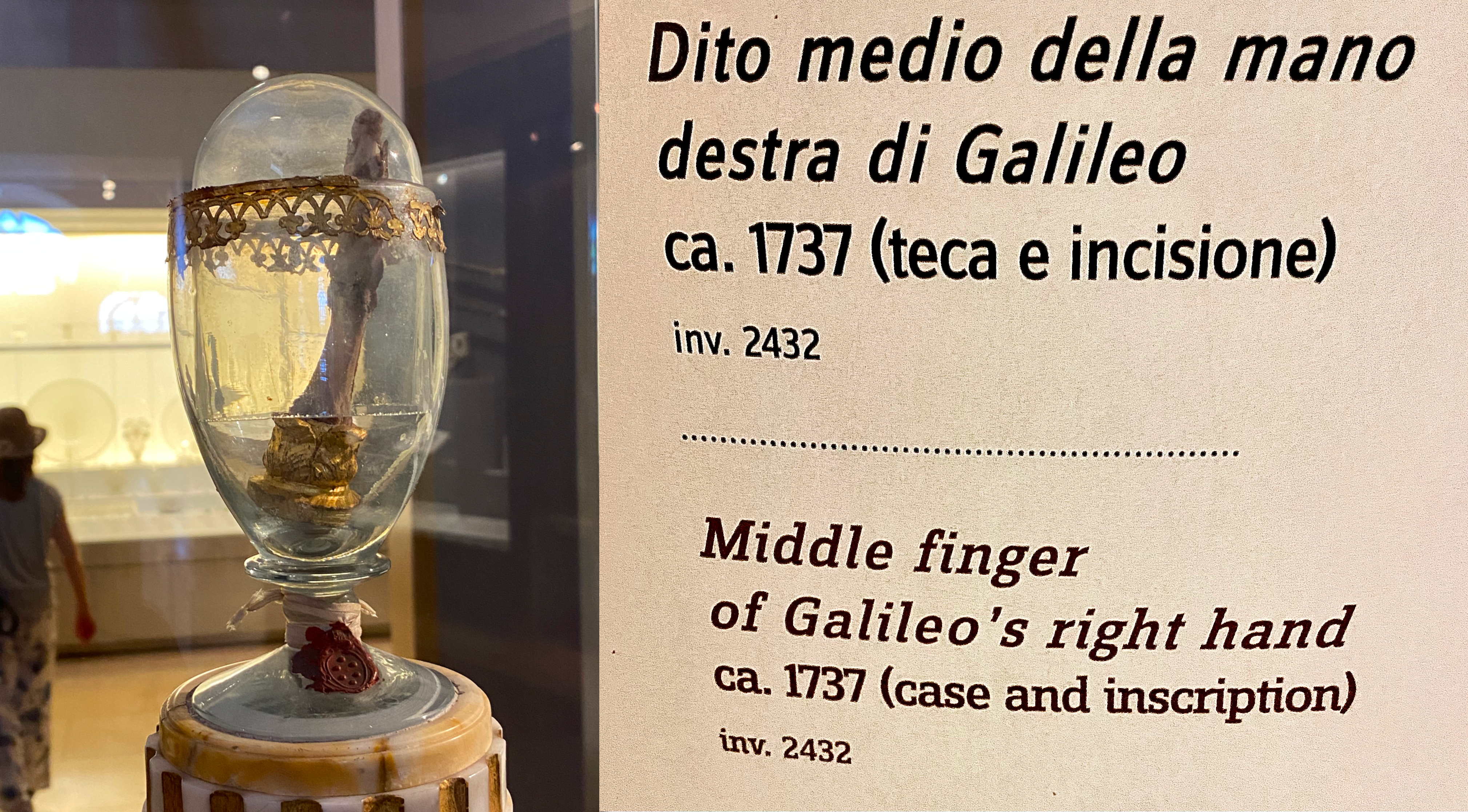
Look what I found in Florence: Galileo’s middle finger. It points skyward toward the vast cosmos he was prosecuted for defending, forever flipping the middle finger at the dogma that tried to silence him. It’s one of the more unusual ways we try to preserve memory, capturing history in the most unexpected objects—much like the test tube reputed to hold Thomas Edison’s last breath and jawbones of Baganda kings.
Yet these human relics force an uncomfortable ethical question: who gets to decide what happens to our remains—the person who claims the relic, or the person whose body it once belonged to? Harvey’s unauthorized removal of Einstein’s brain lays this ethical question bare, but also introduces a different aspect—that remains can be taken for scientific endeavors or organ donation. But unlike organ donation, where a body part is taken to continue life, a relic is taken to freeze a legacy.
Must a relic be bodily? For decades, my grandma kept my father’s brittle, yellowing campaign poster pinned to her wall, proving that a simple scrap of aging paper can serve as a powerful anchor to the past. While touching that paper, I often wondered: must an anchor be part of the history itself to unlock the memory, or can a travel magnet from Florence hold the power to resurrect a specific chapter of a journey in Hamburg? The power of a relic lies not in its physical origin, but in the personal narrative we project onto it—a truth that perhaps explains why bodily relics hold an even deeper, more sobering sway. Galileo Galilei’s preserved finger not only evokes his scientific legacy but also forces us to confront our own mortality, reminding us that even the brightest sparks are eventually extinguished.
Memory fades, memory adjusts, memory conforms to what we think we remember — Joan Didion
Technology, and the advent of AI, is broadening the range of what can serve as relics or anchors of memory. The Pacific island nation of Tuvalu, threatened by rising sea levels, is creating a digital twin of itself—attempting to preserve its land, culture, and identity in the virtual world rather than gathering physical relics to display in a museum. On a smaller scale, physical remains that were previously incinerated and kept as ash in urns are now transformed into lab-grown diamonds or vinyl records. We also build AI avatars to converse with digital echoes of the departed, rather than relying on human mediums to bridge the divide between life and death. We have moved from severing physical parts of ourselves to taking selfies.
Do we actually manage to preserve a memory by preserving a relic? Lenin’s embalmed body is still displayed in Red Square and meticulously cared for, but the memory it holds today is far from the memory of 1924. During the protests following the murder of George Floyd, statues that had once been revered were vandalised and toppled. We preserve the relic because we want to freeze the fluid and fleeting memory, but an object cannot preserve the context that birthed it. Our relationship with the past evolves as both time and space change. Legacies and memories are moving targets.
While a massive monument like Mount Rushmore shapes collective memory by compelling a nation to remember its history, smaller relics, like handwritten letters, evoke a much more intimate memory. Probing this contrast reveals that the true value of a relic isn’t found in scale, price, or permanent preservation; even the catacomb saints, once adorned with gold and jewels by the Catholic Church, don’t necessarily evoke memories more vividly than Galileo’s simple dry bone. The value of the relic lies not in recreating the original context, but in its ability to spark personal meaning and sustain a living connection to the past for whoever interacts with it. If the physical relic is permanent, but its original context is transient, how then can we reconstruct that initial reality when the anchor alone can no longer speak the dead language of its origin? Answers on a postcard.